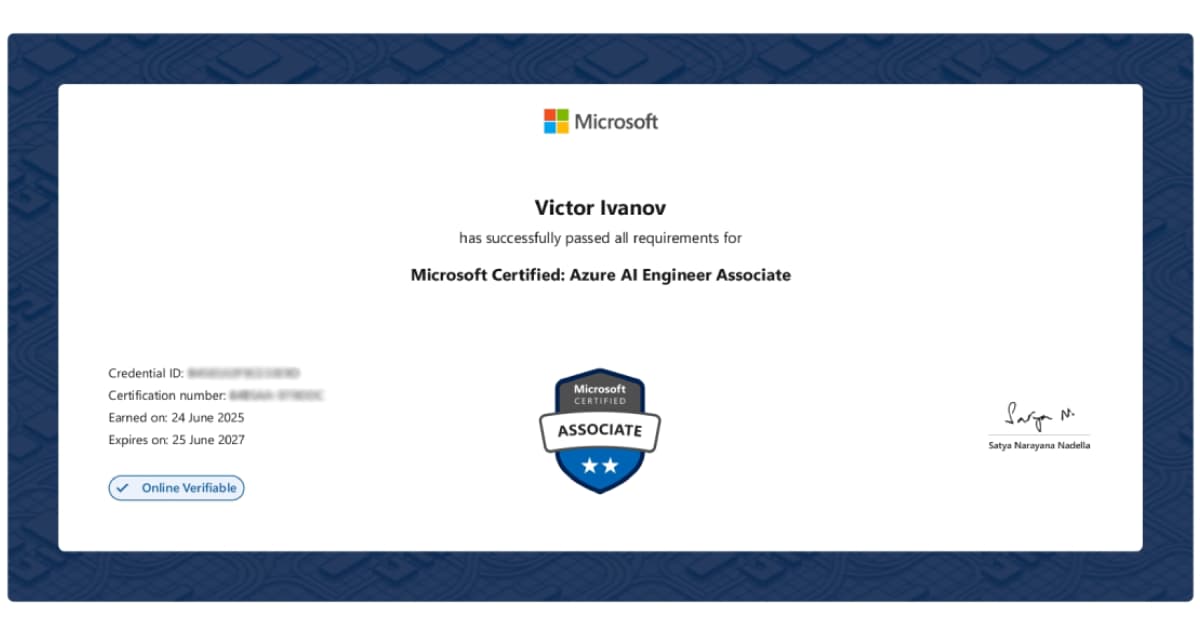
The Udemy practice tests I bought for AI-102 contained mostly the same questions as the real exam. I could have skipped six weeks of studying, memorized the answers, and nobody would have known. I studied anyway, passed on the first attempt with 936 out of 1000 in June 2025, and a year later Microsoft retired the exam entirely.
So, dead exam, questionable prep market, was any of it worth it? Yes. But not because of the badge. The badge was the vehicle. What I was actually buying was the skill of integrating AI services into web applications, and that skill is aging in exactly the opposite direction of the exam.
AI services are a fullstack skill now
Nobody sent me to this certification. I took it because of a conviction I still hold: the apps we build will look and feel different in the near future, and the difference will come from AI expansions built into ordinary products. Not new AI companies, not research labs. Regular web apps, quietly getting smarter.
For a frontend-leaning fullstack developer like me, that changes the job description. Most product features will never need a model trained from scratch. They need someone who knows which service fits which problem, how to authenticate it, what it costs at scale, and how to wire it cleanly into an existing app. That's integration work, and integration work is what fullstack developers do.
And when someone objects with "but our data can't leave the building": in some cases you really do need local or internal systems, but platforms like Azure and AWS already give you containerized deployments, private networks, and serious security options. The excuses for not learning this stuff are getting thinner every quarter.
Six weeks, 936 points
My preparation was boring, and I mean that as a recommendation. The official learning path and study guide plus the hands-on labs are a must: not optional, not "if you have time." The exam is scenario-driven, and the scenarios only click if you've actually provisioned the services and hit their APIs yourself.
On top of that I watched the AI-102 Study Cram from John Savill's Technical Training, which compresses the whole surface area into a couple of hours and is excellent for finding your weak spots.
Total effort: 8 to 10 hours a week for about five to six weeks, alongside a full-time job. The exam itself was online proctored, with partial access to Microsoft Learn during the test. Honestly, nothing surprised me on exam day. Everything was exactly as Microsoft describes it, which is its own kind of praise.
The dump questions, honestly
Here's the part most certification write-ups skip, so let me not skip it.
I bought a Udemy course called "Azure AI Engineer Associate AI-102 : Practice Tests (2025)". It's no longer available, and having taken the real exam, I understand why: most of its questions were the same as the ones I saw in the actual test. Not similar. The same.
Let me be direct about what that means: I think anyone could pass AI-102 on those dumps alone, with zero understanding of a single Azure service. I bought the course as extra preparation, mostly for the tricky edge-case questions, and for that it genuinely helped. But it also told me exactly how much a pass can be worth: sometimes, nothing.
So why bother doing it honestly? Because of what the certificate actually claims. It says "I can work with these services." If you cheated your way to it, you're not lying to Microsoft, you're lying to your employer and to yourself, and both lies have a short shelf life. The first real ticket that lands on your desk will out you, and then you've lost your time, your employer's time, and some respect that's hard to win back. What matters at the end was never the paper: it's whether you can bring value to the project. The exam is just a decent forcing function for building the knowledge that does.
What I built with it: a greenhouse that talks back
The best proof that the knowledge stuck is what happened after the exam. For my university thesis I built a physical prototype: a mini greenhouse at home, growing Bolivian Rainbow chili peppers, with sensors and actuators tracking temperature, humidity, soil moisture, and light.
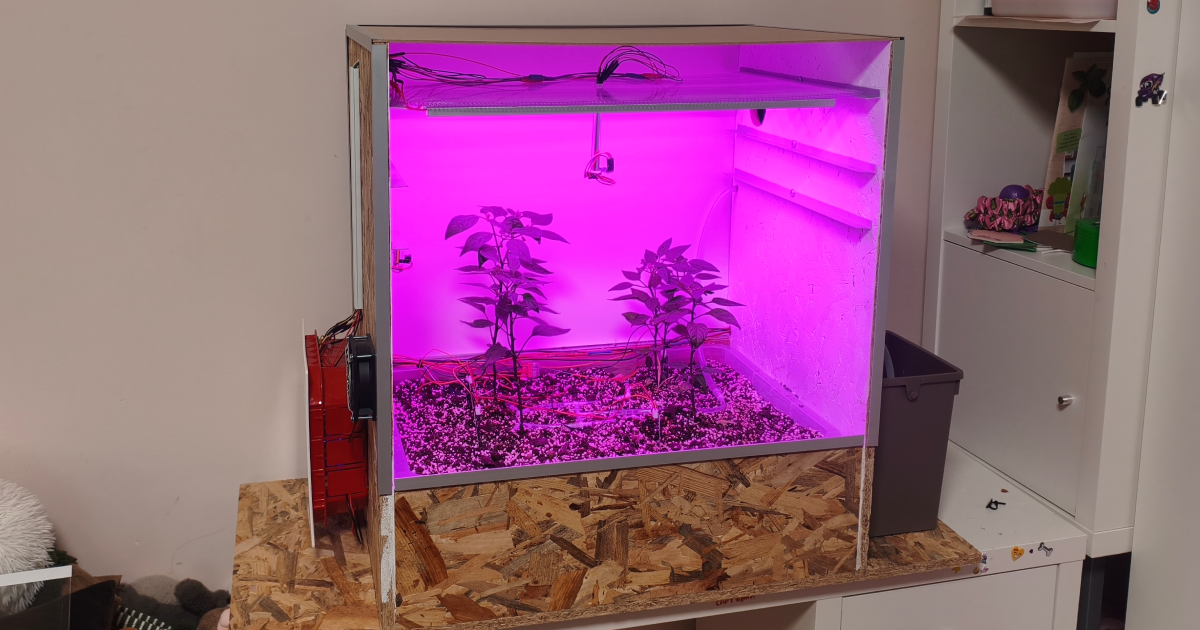
The interesting part is the assistant on top of it. The ESP devices report through Azure IoT Hub to a backend hosted on Azure App Service, with users and application data in Firestore and a small web portal on top. Knowledge about this specific pepper variety lives in Supabase as a vector store, so the assistant is grounded with RAG instead of guessing from generic training data. Azure OpenAI ties it together: I can ask "what do you think about my temperature over the last week?" and it combines the live sensor history with the variety-specific knowledge and answers correctly. I also attach a timelapse photo, stored in Azure Storage, so the model can literally see how the peppers are doing.
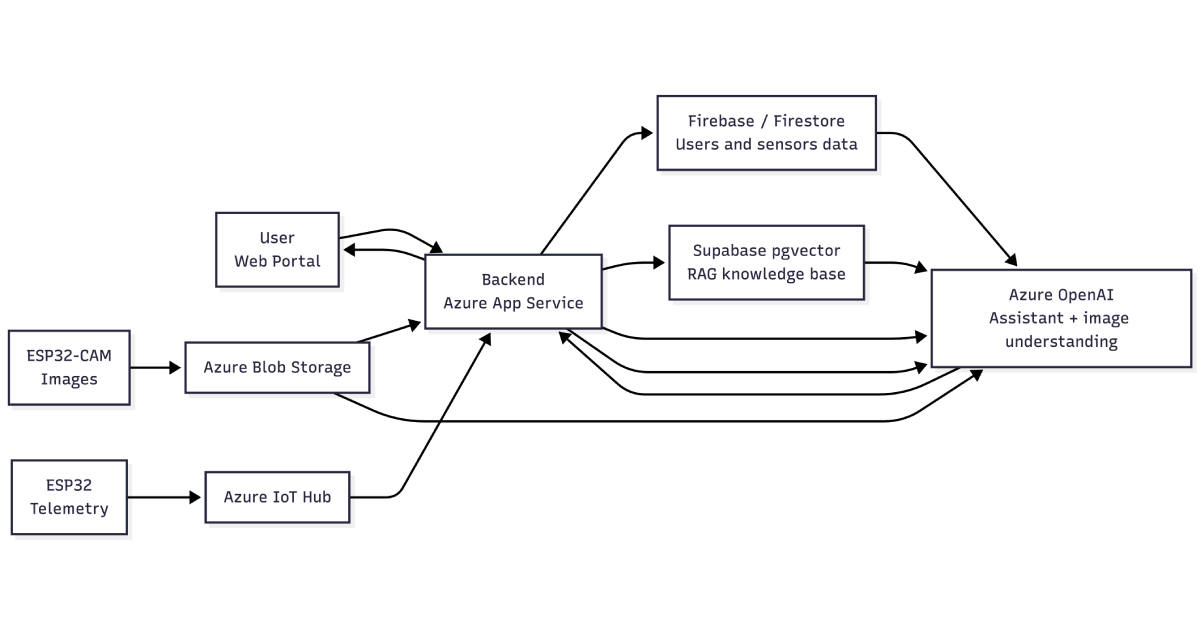
One decision I'm particularly happy with: I deliberately did NOT use Azure AI Vision, even though "image in, insights out" sounds like its job description. Its tags and descriptions are too general to say anything useful about chili plants. Knowing when a service is the wrong tool is exactly the judgment the certification trains, and it's worth more than knowing every SDK by heart.
And the number that still makes me smile: the Azure bill for about two months of running all of this was 1.45 EUR. Integrating AI services isn't just approachable, it can be almost embarrassingly cheap at prototype scale.
The greenhouse deserves its own post, and it will get one. Consider this the teaser.
The exam retired. The skill didn't.
On June 30, 2026, Microsoft retired AI-102. Its successor is AI-103, the Azure AI Apps and Agents Developer Associate, rebuilt around agents and Microsoft Foundry. I saw it coming and renewed my certification in mid-May, so it stays current on my transcript: you can verify it on Microsoft Learn. AI-103 is on my list. When I take it, you'll read about it here.
But here's the point of this whole article: the retirement changed almost nothing about the value. On my current project we use AWS Bedrock, which is pretty much AWS's alternative to the Azure AI services, and the knowledge transferred almost one-to-one. Grounding a model in your data, picking the right service tier, securing keys, watching costs: the concepts are identical, only the console changes color.
If you're an app developer wondering whether this is worth your time: yes, and sooner than you think. If you're starting today, aim at AI-103 rather than mourning AI-102. Do the official learning path, do the labs for real, and treat practice tests as a check of your knowledge, not a substitute for it. You know my opinion on the alternative.
And whichever way you go: the certificate is the receipt, not the product. The product is being the person on the team who can take an ordinary web app and make it genuinely smarter with a few well-chosen services and a small bill.
If you're preparing for an Azure AI certification, or stuck integrating one of these services into your app, reach out. I've walked colleagues through this before, and I'm glad to help.